Sample Content
BackInAction Knee muscle-sparing approach with Mako SmartRobotics™
We understand that knowing what to expect from your joint replacement experience is important to you. As you are reading through this material, please reach out to us to discuss if you have additional questions.
Each patient is unique and can experience joint pain for different reasons. It’s important to talk to us about the reason for your knee pain so you can understand the treatment options available to you. Pain from arthritis and joint degeneration can be constant or come and go, occur with movement or after a period of rest, or be located in one spot or many parts of the body. It is common for patients to try medication and other conservative treatments to treat their knee pain.
If you haven’t experienced adequate relief with those treatment options, you may be a candidate for BackInAction Knee, a muscle-sparing knee replacement with Mako SmartRobotics which may provide you with relief from your knee pain.
What is the BackInAction Knee?
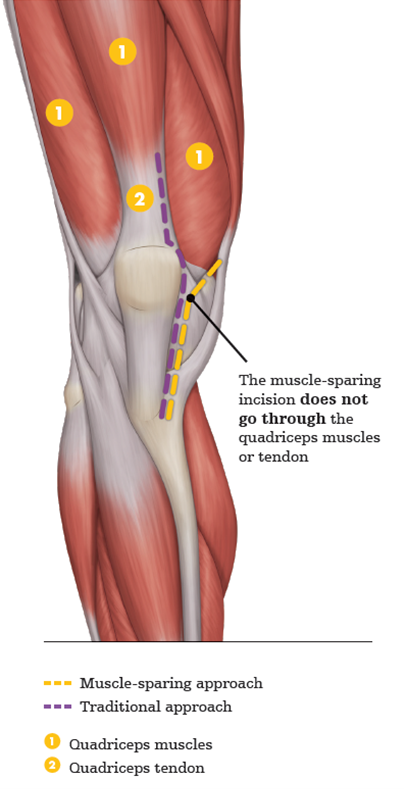
During knee replacement surgery, your doctor has to get past the kneecap (patella) and soft tissue (muscle and tendons) surrounding the knee to access the bones of the joint. In a traditional approach, the surgeon clears a path for performing the knee replacement by making an incision along the inner side of the kneecap – cutting through one of the largest muscle groups in the body, the quadriceps. After the joint replacement is completed, the surgeon sutures any cuts made in the quadriceps and tendons.
The quadriceps run from the hip to the knee at the front of the leg. The normally powerful quadriceps play an important role in many everyday movements, like walking, standing up and climbing stairs. When this muscle is cut during traditional knee replacement surgery, it needs plenty of time to heal and during that time, it may feel weak and painful to move.
That’s where the BackInAction Knee comes in. When performing a total knee replacement with Mako SmartRobotics, your surgeon may choose to use a muscle-sparing approach. With this technique, the surgeon lifts and moves – rather than cuts – the quadriceps to gain access to the joint. By working around rather than through the quadriceps, the surgeon can help minimize the impact on the quadriceps muscles and tendon. This can result in less pain and faster recovery than a traditional approach.1,2
IMPORTANT INFORMATION
Total knee replacement is intended for use in individuals with joint disease resulting from degenerative, rheumatoid and post-traumatic arthritis, and for moderate deformity of the knee. Knee replacement surgery is not appropriate for patients with certain types of infections, any mental or neuromuscular disorder which would create an unacceptable risk of prosthesis instability, prosthesis fixation failure or complications in postoperative care, compromised bone stock, skeletal immaturity, severe instability of the joint, excessive body weight or known or suspected sensitivity and/or allergy to any material in the device.
As with any surgery, knee replacement surgery has serious risks which include, but are not limited to, pain, infection, bone fracture, peripheral neuropathies (nerve damage), circulatory compromise (including deep vein thrombosis (blood clots in the legs)), genitourinary disorders (including kidney failure), gastrointestinal disorders (including paralytic ileus (loss of intestinal digestive movement)), vascular disorders (including thrombus (blood clots), blood loss, or changes in blood pressure or heart rhythm), bronchopulmonary disorders (including emboli, stroke or pneumonia), heart attack, and death.
Implant related risks which may lead to a revision include dislocation, loosening, fracture, nerve damage, heterotopic bone formation (abnormal bone growth in tissue), wear of the implant, metal and/or foreign body sensitivity, soft tissue imbalance, osteolysis (localized progressive bone loss), and reaction to particle debris. Knee implants may not provide the same feel or performance characteristics experienced with a normal healthy joint. The information presented is for educational purposes only. Speak to your doctor to decide if joint replacement surgery is appropriate for you. Individual results vary and not all patients will return to the same activity level. The lifetime of any joint replacement is limited and varies with each individual. Your doctor will counsel you about how to best maintain your activities in order to potentially prolong the lifetime of the device. Such strategies include not engaging in high- impact activities, such as running, as well as maintaining a healthy weight. It is important to closely follow your doctor’s instructions regarding post-surgery activity, treatment and follow-up care.
Ask your doctor if a knee replacement is right for you.
Stryker Corporation or its divisions or other corporate affiliated entities own, use or have applied for the following trademarks or service marks: Mako, SmartRobotics, Stryker. All other trademarks are trademarks of their respective owners or holders.
References
- Stubnya BG, Kocsis K, Váncsa S, Kovács K, Agócs G, Stubnya MP, Suskó E, Hegyi P, Bejek Z. Subvastus Approach Supporting Fast-Track Total Knee Arthroplasty Over the Medial Parapatellar Approach: A Systematic Review and Network Meta-Analysis. J Arthroplasty. 2023 Dec;38(12):2750-2758.
- Liu HW, Gu WD, Xu NW, Sun JY. Surgical approaches in total knee arthroplasty: a meta-analysis comparing the midvastus and subvastus to the medial peripatellar approach. J Arthroplasty. 2014 Dec;29(12):2298-304.
JR-GSNPS-PTNT-1860700 Rev.1